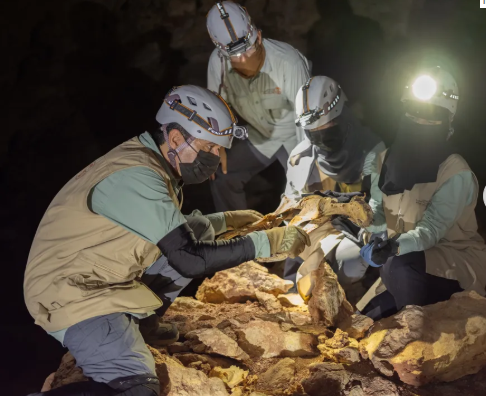
Scientists have successfully extracted the DNA of ancient mummified cheetahs discovered in a cave in Saudi Arabia. This is the first time scientists have been able to extract genetic information from ancient naturally mummified big cats, researchers say, and it could lead to the animals’ reintroduction to the region.
In a new study, published Thursday, January 15 by Communications Earth & Environment, indicate that at least two cheetah subspecies once thrived on the Arabian Peninsula, where they went locally extinct in the 1970s. In the study, researchers dated samples from two of the mummified cheetahs and five of the skeletons. The oldest skeletal remains belong to a cheetah that died about 4,000 years ago, while the two desiccated cheetahs are 130 and 1,870 years old respectively.
Cheetahs were formerly native to the Arabian Peninsula but were wiped out in the 1970s due to habitat loss and hunting.
To shed some light on this animal, cheetahs are usually known as the fastest animal on earth. The cheetah’s body is built like a high-performance machine, as cheetahs can accelerate from 0 to 60 mph in just three seconds.
It has been said they can burst up to 75 mph (120 km/h). Wow that’s fast!
Another fun fact about cheetahs is that they have many unique characteristics, such as meowing like normal house cats. They also chirp, purr, and hiss, because their vocal anatomy is more like smaller felines, preventing them from roaring like lions or tigers.
They can’t roar due to a fixed voice box, but this structure allows them to purr continuously and make house-cat-like sounds for communication, especially between mothers and cubs. Here is a YouTube link to hear them in action –> Meowing cheetahs.
Another fact is that male cheetahs can form small groups while females are solitary, and they hunt during the day, unlike most other big cats.